
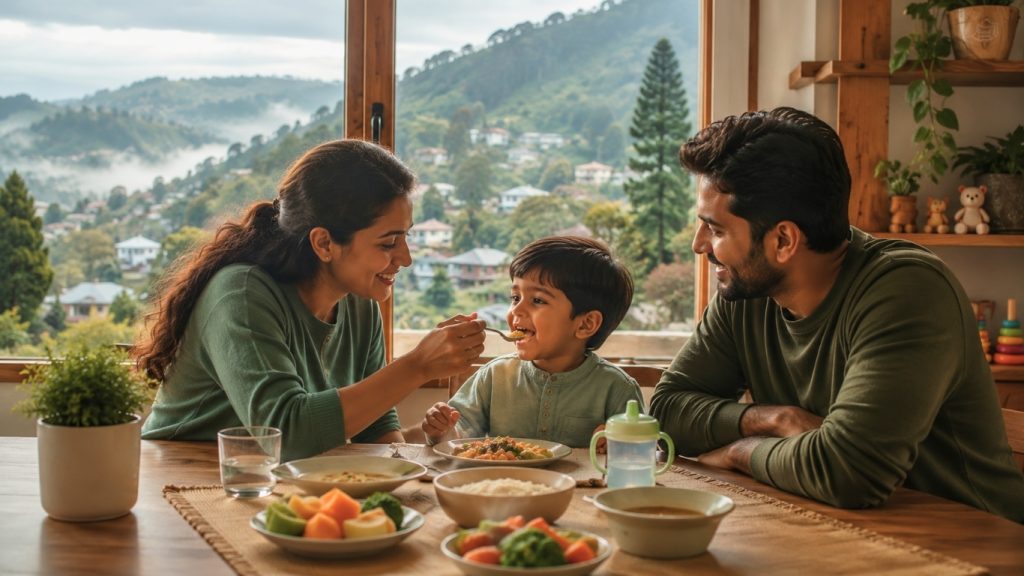
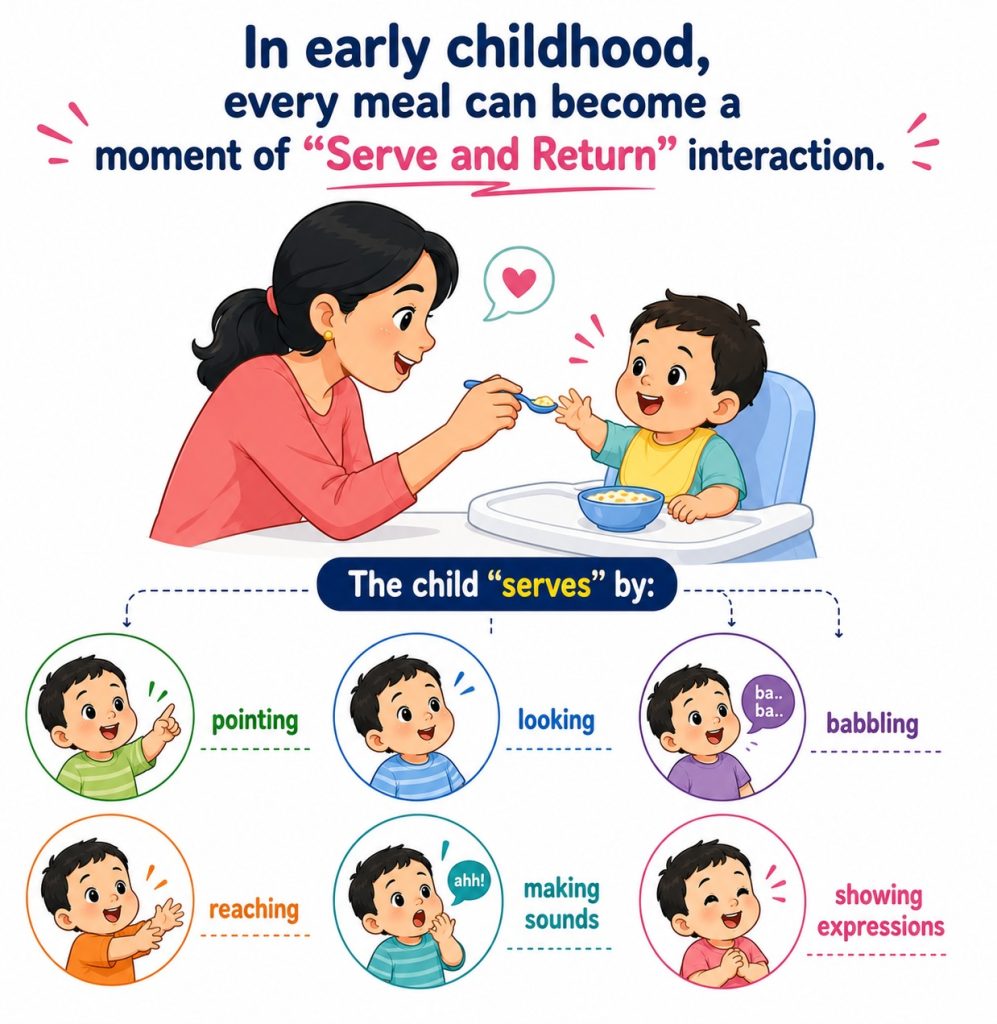
In early childhood, every meal can become a moment of “Serve and Return” interaction.
 The child “serves” by:
 pointing looking babbling reaching making sounds showing expressions
 The parent “returns” by:
 responding
🗣 talking making eye contact
 taking turns
 sharing emotions
These simple back-and-forth interactions help build brain connections.
 “You like banana?”
 “More sambar?”
 “Crunch crunch carrot!” “Wow, you tasted it!”
 “Is it yummy?”
What are the advantages of a family mealtimes providing rich interaction?*
🍽 Mealtimes naturally provide: Smells
 Tastes
 Textures
 Colors
 Sounds
This creates a powerful multisensory learning environment. Mealtimes are pleasurable as they produce a *dopamine surge*.
Fostering child development over mealtimes also will become pleasurable to the child as the child will associate these experiences with the *dopamine surge*
Mealtimes are not only to fill tummies.
Mealtimes must provide a holistic experience to the child
Connection
🗣 Conversation Shared joy Belonging
Because as children grow up…
They may forget:  what they ate how much they ate
But they will always remember: how they ate.
The feeling.
The togetherness.
The connection.
Simple ideas to make mealtimes developmentally stimulating and enriching
Keep at least one meal screen-free
Make sure all members of the family are together at mealtime atleast for one meal
✔ Sit face-to-face when possible
✔ Name foods, colors, textures
✔ Wait for the child to respond
✔ Encourage pointing and choices
✔ Use gestures and facial expressions
✔ Talk slowly and warmly
✔ Allow toddlers to explore food
✔ Avoid pressure and force-feeding
Most of you would agree that- Screens in our homes are on during mealtimes and we all are screen distracted when eating
We do not eat mindfully any more
The kids at our home aren’t eating mindfully
When we are screen distracted during mealtimes, we miss:
– Appreciating the taste of the food, the smell and texture of the food
– The satiety signals- we tend to overeat
– Chewing the food well, affecting the digestion
The commonest reasons parent say for early introduction of screentime in infancy or toddlerhood (despite knowing about its harms) is
We started screens so the child would eat…
_Many families do not begin screens for educational purposes or for entertainment of the child_
They begin with anxiety: “My child is not eating.” “He is too fussy.” “Only if mobile is on, he/she opens her mouth.”
Over time, feeding becomes linked to distraction.
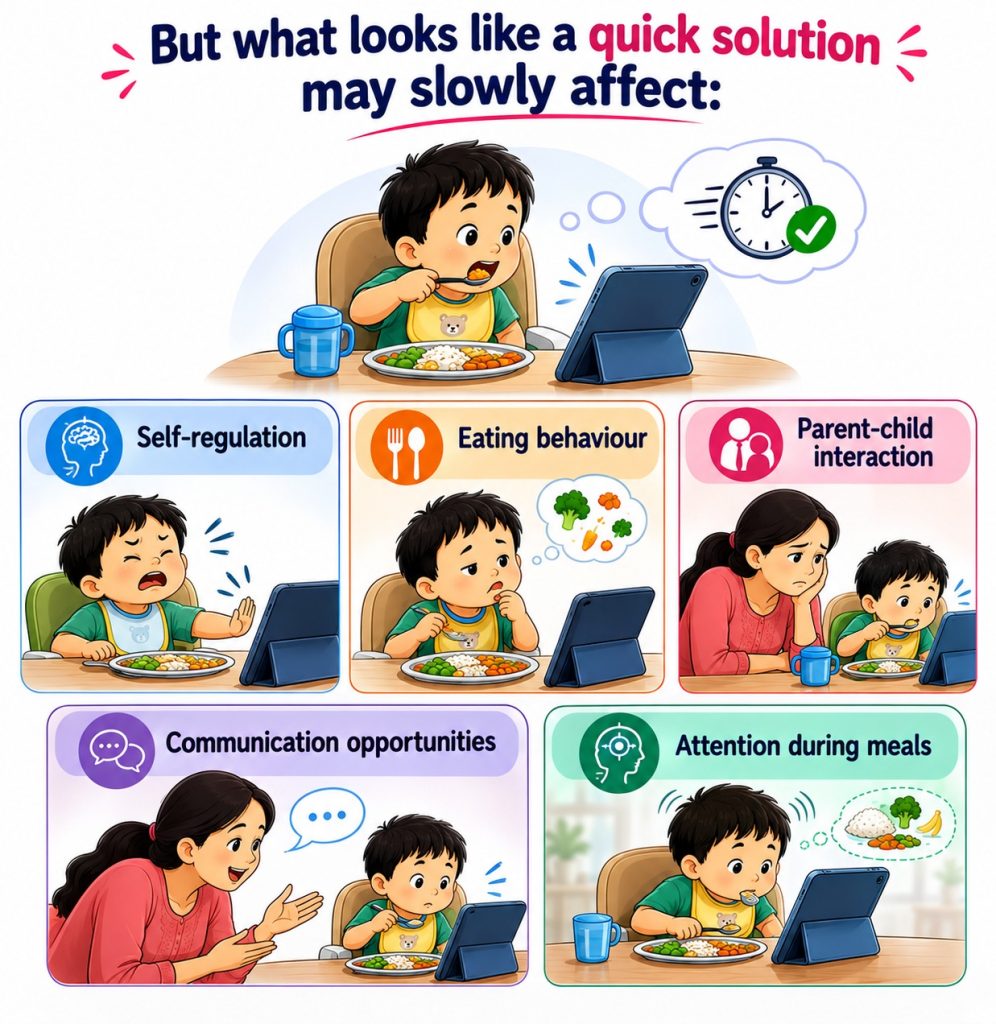
But what looks like a quick solution may slowly affect: self-regulation
🍽 eating behaviour parent-child interaction
🗣 communication opportunities attention during meals
The serve and return opportunities that we discussed during mealtimes are lost
Food + Screens = “Distracted Eating”
When food and screens are paired together: dopamine stimulation increases significantly children may become more dependent on distraction during meals- overtime due to desenstization, they seek more screentime or more comfort food to get the dopamine surge eating becomes less mindful
Studies show children may: take larger bites
 chew less
 recognize fullness cues less effectively- end up eating more
 become more screen-dependent during feeding
The child may finish the meal…
without truly experiencing the meal..
It leads to unhealthy weight and developmental concerns- acquisition of language and social emotional development is most affected
These are public health concerns that we are facing today.